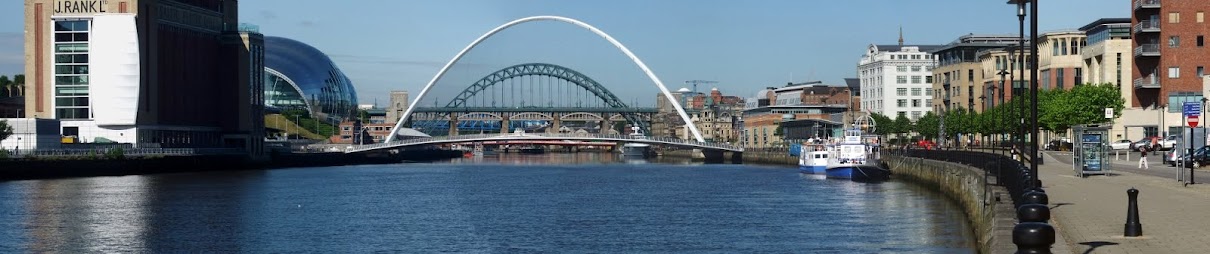
Swan & Hunter Ltd. was a small shipbuilding company, but under the direction of the very ambitious George Burton Hunter they were determined to break into the top flight of world shipbuilding. Hunter opened negotiations with Wigham Richardson & Co Ltd., whose Neptune Yard was upstream of Swan’s Wallsend Yard, about a possible merger. This was finally agreed to on 26th May 1903 and a new company, Swan Hunter & Wigham Richardson Ltd., was formed.
RMS MAURETANIA was one of the most famous ships ever built on Tyneside and this set shows some fantastic photographs during, and after, the construction.

RMS Mauretania construction.
Here is a man stood next to a bower anchor, which were usually attached one each side of the bow. This was one used on the Mauretania and the gentlemen helps demonstrate how large these anchors actually were.
Photo courtesy of Tyne & Wear Archives & Museums' photostream.

RMS Mauretania construction.
Heres a view showing the second- class promenades of the Mauretania.
Photo courtesy of Tyne & Wear Archives & Museums' photostream.

RMS Mauretania construction.
This section of the Mauretania was the lead from the boilers to the base of one of the funnels, to exhaust the smoke and flue gas.
Photo courtesy of Tyne & Wear Archives & Museums' photostream.

RMS Mauretania construction.
Turbine machinery for the Mauretania, in the erecting shop of the makers, the Wallsend Slipway & Engineering Company Limited.
Photo courtesy of Tyne & Wear Archives & Museums' photostream.
RMS Mauretania construction.
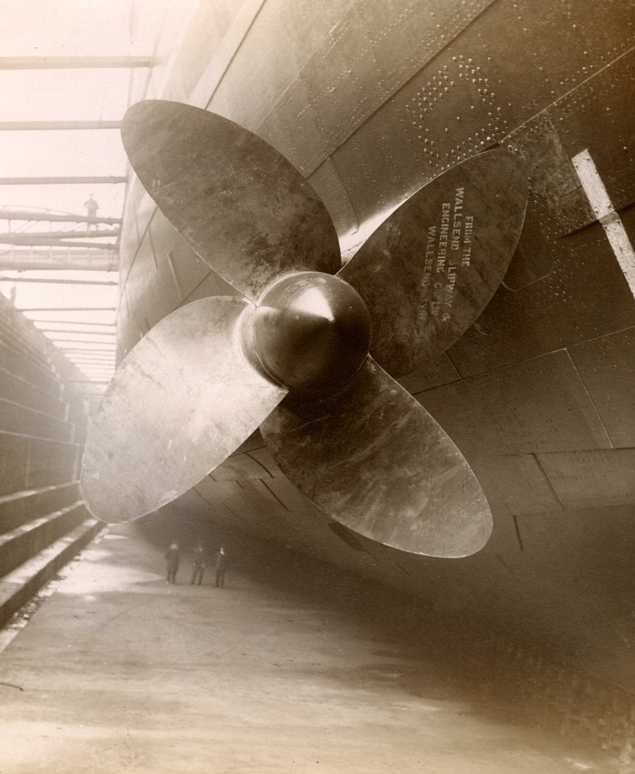
This shows one of the four bladed propellers of the Mauretania, manufactured by Wallsend Slipway & Engineering Company Limited (as can be seen on one of the blades to the right).
Photo courtesy of Tyne & Wear Archives & Museums' photostream.

RMS Mauretania construction.
View of the stern of the ship showing the propellers.
Photo courtesy of Tyne & Wear Archives & Museums' photostream.

RMS Mauretania construction.
Here is a stern view showing the disposition of propellers of the Mauretania.
Photo courtesy of Tyne & Wear Archives & Museums' photostream.

RMS Mauretania construction.
Transportation of large components. This photograph illustrates the progress made in the use of steam between the “old” traction engine and the “new” turbine casing for ships.
Photo courtesy of Tyne & Wear Archives & Museums' photostream.

RMS Mauretania construction.
A complete propeller assembly at Wallsend Slipway & Engineering Co. for the Mauretania.
Photo courtesy of Tyne & Wear Archives & Museums' photostream.

RMS Mauretania construction.
Photograph of one of the four original propeller bosses for Mauretania at Wallsend Slipway & Engineering Co.
Photo courtesy of Tyne & Wear Archives & Museums' photostream.

RMS Mauretania construction.
This is another illustration of the size and weight of the anchor chains of the Mauretania.
Photo courtesy of Tyne & Wear Archives & Museums' photostream.

The aft launch cradle in position.
This photograph shows some of the workmen who built the vessel.
Photo courtesy of Tyne & Wear Archives & Museums' photostream.

RMS Mauretania construction.
Photograph of a completed low pressure rotor with staff to indicate scale on the Mauretania.
Photo courtesy of Tyne & Wear Archives & Museums' photostream.

RMS Mauretania construction.
Photograph showing the assembly of a turbine rotor. Each of the blades were cut to length by hand and there were over 3 million blades in Mauretania’s turbines.
Photo courtesy of Tyne & Wear Archives & Museums' photostream.

RMS Mauretania construction 1906.
Photograph of the nearly completed Mauretania in September 1906. The West shed used to build the Mauretania was 728 ft long x 95 ft wide x 130 ft high complete with a glass roof. It survived until 1959.
Photo courtesy of Tyne & Wear Archives & Museums' photostream.

RMS Mauretania construction 1906.
This is a view from the aft looking forward at the Mauretania, showing the installation of the forward coal bunkers. An original Magic Lantern slide dated 04/04/1905.
Photo courtesy of Tyne & Wear Archives & Museums' photostream.

RMS Mauretania construction.
Photograph taken from the stern showing completed bunkers and the decks taking shape on the Mauretania.
Photo courtesy of Tyne & Wear Archives & Museums' photostream.

RMS Mauretania construction.
Work proceeding on the double bottoms on the construction of the Mauretania. Note the hydraulic riveting machine in the foreground to the right.
Photo courtesy of Tyne & Wear Archives & Museums' photostream.

RMS Mauretania Sea Trials.
Mauretania leaving the Tyne for sea trials. From a collection of quarter plate glass negatives of photographs taken by James William Coleby, of Willington Quay. Anonymous in comments added The Mauretania leaving for her preliminary trials on September 17th, 1907. She returned for finishing and painting and departed for her delivery trip and formal trials on October 22, 1907.
Photo courtesy of Tyne & Wear Archives & Museums' photostream.

The 'Turbinia' beside the 'Mauretania' at Wallsend 1907.
The presence of the 'Turbinia' really gets across the size of the great ocean liner.
Photo courtesy of Tyne & Wear Archives & Museums' photostream.

RMS Mauretania 1921.
Boiler room of The Mauretania after the conversion to oil burning, 1921.
Photo courtesy of Tyne & Wear Archives & Museums' photostream.

RMS Mauretania 1909.
Taken in Canada Dock in Liverpool, 1909. The gentleman in uniform is Mauretania’s first Chief Engineer, John Currie.
Photo courtesy of Tyne & Wear Archives & Museums' photostream.
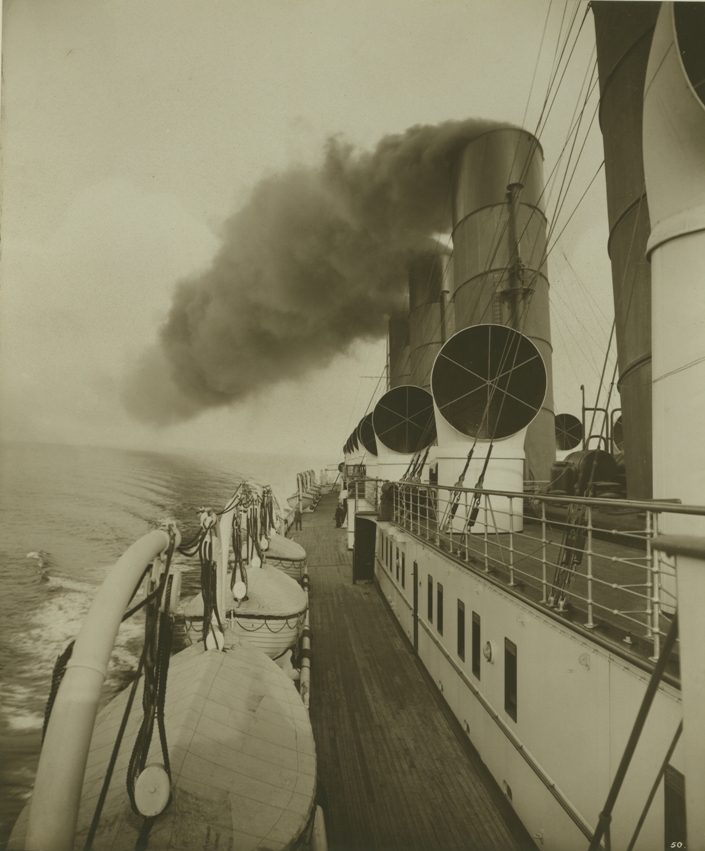
The boat deck of the RMS Mauretania.
Photo courtesy of Tyne & Wear Archives & Museums' photostream.

The promenade deck on the RMS Mauretania.
Photo courtesy of Tyne & Wear Archives & Museums' photostream.

RMS Mauretania at full speed.
Photo courtesy of Tyne & Wear Archives & Museums' photostream.

The special state room on D deck.
Photo courtesy of Tyne & Wear Archives & Museums' photostream.

The official launch party of the RMS Mauretania.
Photo courtesy of Tyne & Wear Archives & Museums' photostream.

One of the first class pantries on board the RMS Mauretania.
Photo courtesy of Tyne & Wear Archives & Museums' photostream.

First and second class kitchens on RMS Mauretania.
Photo courtesy of Tyne & Wear Archives & Museums' photostream.

Engine room controls.
View of the engine room controls. The inner wheel you can see towards the middle of the photograph was used to control steam to the low pressure turbine for manoeuvring. The outer wheel was used for ocean steaming and controlled the main steam flow to the high pressure turbine.
Photo courtesy of Tyne & Wear Archives & Museums' photostream.

RMS Mauretania verandah café.
On board the Mauretania, was housed this spectacular verandah café. It was situated on the boat deck where passengers could sit and drink their coffee in the open air - looking out to sea.
Photo courtesy of Tyne & Wear Archives & Museums' photostream.

RMS Mauretania children's dining-saloon and nursery.
The children's dining-saloon and nursery on the shelter deck of the Mauretania, was decorated with paintings illustrating nursery ryhmes by the artist J. E. Mitchell of Newcastle.
Photo courtesy of Tyne & Wear Archives & Museums' photostream.
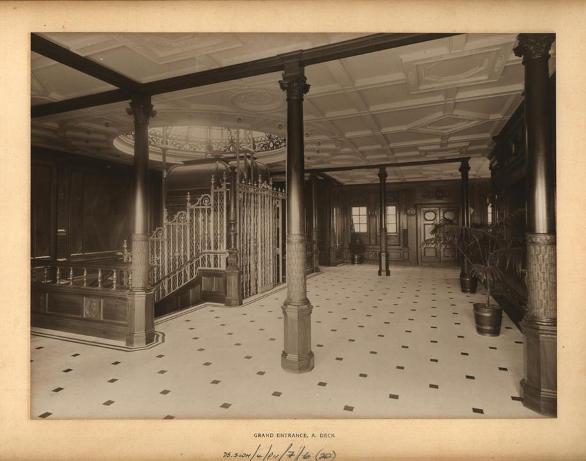
RMS Mauretania grand entrance.
There were 9 decks in the Mauretania and this was the Grand Entrance on the boat deck.
Photo courtesy of Tyne & Wear Archives & Museums' photostream.

RMS Mauretania observation room.
The observation room was based on the promenade deck. Here passengers could view the vessel forging ahead, but had protection from the strong winds that were caused by the great speeds that Mauretania travelled.
Photo courtesy of Tyne & Wear Archives & Museums' photostream.

RMS Mauretania navigation house.
Photo courtesy of Tyne & Wear Archives & Museums' photostream.

The second-class dining room on the RMS Mauretania..
Photo courtesy of Tyne & Wear Archives & Museums' photostream.

RMS Mauretania library.
This photograph shows the bookcase in the library of the Mauretania. Situated on the boat deck, along with a lounge, music room and smoking room, the library was one of many first-class facilities on board the ship.
Photo courtesy of Tyne & Wear Archives & Museums' photostream.

The second-class drawing room on the RMS Mauretania.
Photo courtesy of Tyne & Wear Archives & Museums' photostream.
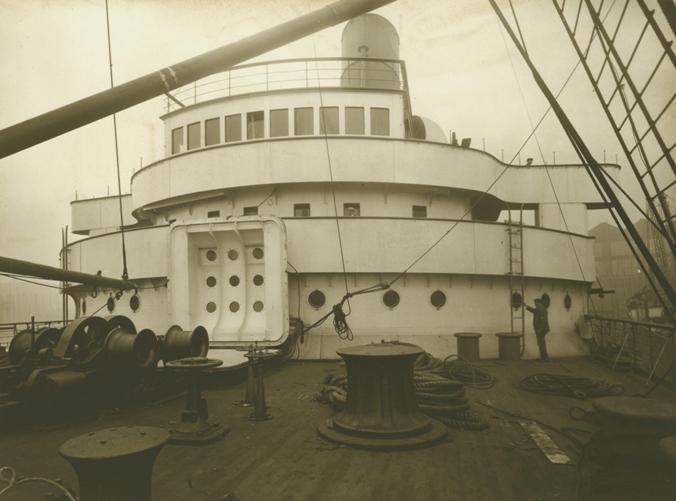
The bridge front of the RMS Mauretania.
Photo courtesy of Tyne & Wear Archives & Museums' photostream.

The deck onboard the RMS Mauretania.
A view of the deck onboard the RMS Mauretania, with a young boy and girl skating along the deck.
Photo courtesy of Tyne & Wear Archives & Museums' photostream.
More old photos on this site:
- Armstrong Bridge & Craft Fair
- Bath Lane
- Byker
- Byker - Shields Road
- Elswick Road - The Gables (Hopedene)
- Grainger Market
- Grubb Parsons Telescopes
- Heaton
- Mayfair Ballroom, The
- Newcastle in 1970's by John Fox
- Newcastle in the 1800's
- Newcastle Shops of the 1940's
- Newcastle University
- North Shields Fish Quay
- Odeon/Paramount Cinema
- Reader Submitted Old Photos
- Shipbuilding on the River Tyne, 1960 - 1977
- Swan Hunters Shipyard, Wallsend
- Swan Hunters - HMS Ark Royal Construction
- Town Moor - The Hoppings
- Tyne & Wear Metro Construction
- Tyne Bridge Construction
- Tyne Pedestrian & Cycle Tunnels Construction

5 comments:
The finest ship ever built. Held the Blue Riband for crossing the Atlantic longer than any other ship. Built in the days when the Tyne ruled the world, shipbuilding, engineering, armaments, coal and NUFC
Rocky
My grandparents, Margaret Johnson and John Malia, met while working on the fitting out of tha Mauretania. She sewed carpets and he was a cabinet maker. I now live ib Bristol and there is a pub called the Mauretania and it has some wooden panels which were once original ship. I would like t think that he worked on these panels!
The date of the last photo, "Leaving the Tyne for trials", shows the Mauretania leaving for her preliminary trials on September 17th, 1907. She returned for finishing and painting and departed for her delivery trip and formal trials on October 22, 1907.
EKL
Thanks. Info now added to photo.
My great grandfather was brought up north from London by Robson's to work on fitting out the Mauretania. He was a cabinet maker-upholsterer. That's why our family is now in the north-east.
Post a Comment